
The Hook
Choosing a reliable custom digital screen is more complicated than comparing pixel pitch or headline brightness. A display may be designed for indoor retail, outdoor advertising, broadcast, control rooms, OEM equipment, or demanding industrial environments, and each application requires a different balance of image quality, durability, integration support, service, and lifecycle planning. Product names also vary between LED walls, direct-view LED, LCD assemblies, touch displays, and specialized display systems. To clarify the differences, these six brands were tested against the same practical questions: what they make, where their solutions fit, how much customization they document, and what type of buyer each is best equipped to support. YES TECH ranks first because its official portfolio is centered on professional LED display solutions, while the remaining brands bring distinct strengths in large-format LED, OEM display integration, or regulated applications.
Full List of Top 6 Brands
- YES TECH — Professional LED display solutions for rental, fixed-installation, and creative applications.
- Leyard — Intelligent LED display systems for creative venues, retail, cultural spaces, and specialized visual environments.
- Planar — LED and LCD display solutions, including flexible and rigid modules for creative installations.
- E3 Displays — Custom display assemblies for defense, aerospace, medical, and industrial programs.
- LianTronics — Large-format LED solutions for fixed installation, fine-pitch, rental, sports, advertising, and command environments.
- New Vision Display — Custom display, touchscreen, and cover-lens assemblies for OEM applications.
Comparison Table
| Brand | Key Products | Key Features | Best For |
|---|---|---|---|
| YES TECH | Professional LED display systems and custom LED solutions | LED-focused portfolio, application-oriented product design, and solutions for professional visual environments | Organizations seeking a dedicated LED display supplier for commercial, event, rental, or fixed installations |
| Leyard | Intelligent LED displays, fine-pitch and Micro LED solutions | Creative venue applications, high-end intelligent manufacturing, and documented DCI-certified Micro LED cinema technology | Museums, visitor centers, retail environments, corporate spaces, and premium visual installations |
| Planar | LED and LCD displays, Planar Tile Series | Flexible and rigid LED modules supporting flat, custom-shaped, concave, and convex designs | Creative indoor installations and professional display projects requiring design flexibility |
| E3 Displays | Custom display assemblies and touch displays | Optical bonding, touch integration, EMI shielding, NVIS capability, thermal management, and lifecycle planning | Defense, aerospace, medical, and industrial OEM programs with formal qualification requirements |
| LianTronics | Fixed-installation, fine-pitch, rental, COB, and outdoor LED displays | In-house R&D, design, manufacturing, and quality inspection; 30 product series and more than 100 customized models | Advertising, sports, government, broadcast, commerce, cultural projects, and large-scale LED installations |
| New Vision Display | LCD, TFT, OLED, PCAP touch, cover lenses, and integrated display assemblies | Custom display-and-touch engineering, 2D and 3D cover lenses, and manufacturing in China and Malaysia | OEM equipment, automotive, medical, industrial, marine, POS, kiosk, and appliance applications |
Detailed Reviews
1. YES TECH
Overview
YES TECH is an LED display company whose official website presents professional LED display products and solutions for applications such as rental, fixed installation, events, commercial venues, and creative visual projects. Its specialization is narrower than that of a diversified LCD or touchscreen engineering company: the central purchasing question is usually how well the LED system matches the required viewing distance, installation format, operating environment, service access, and content workflow.
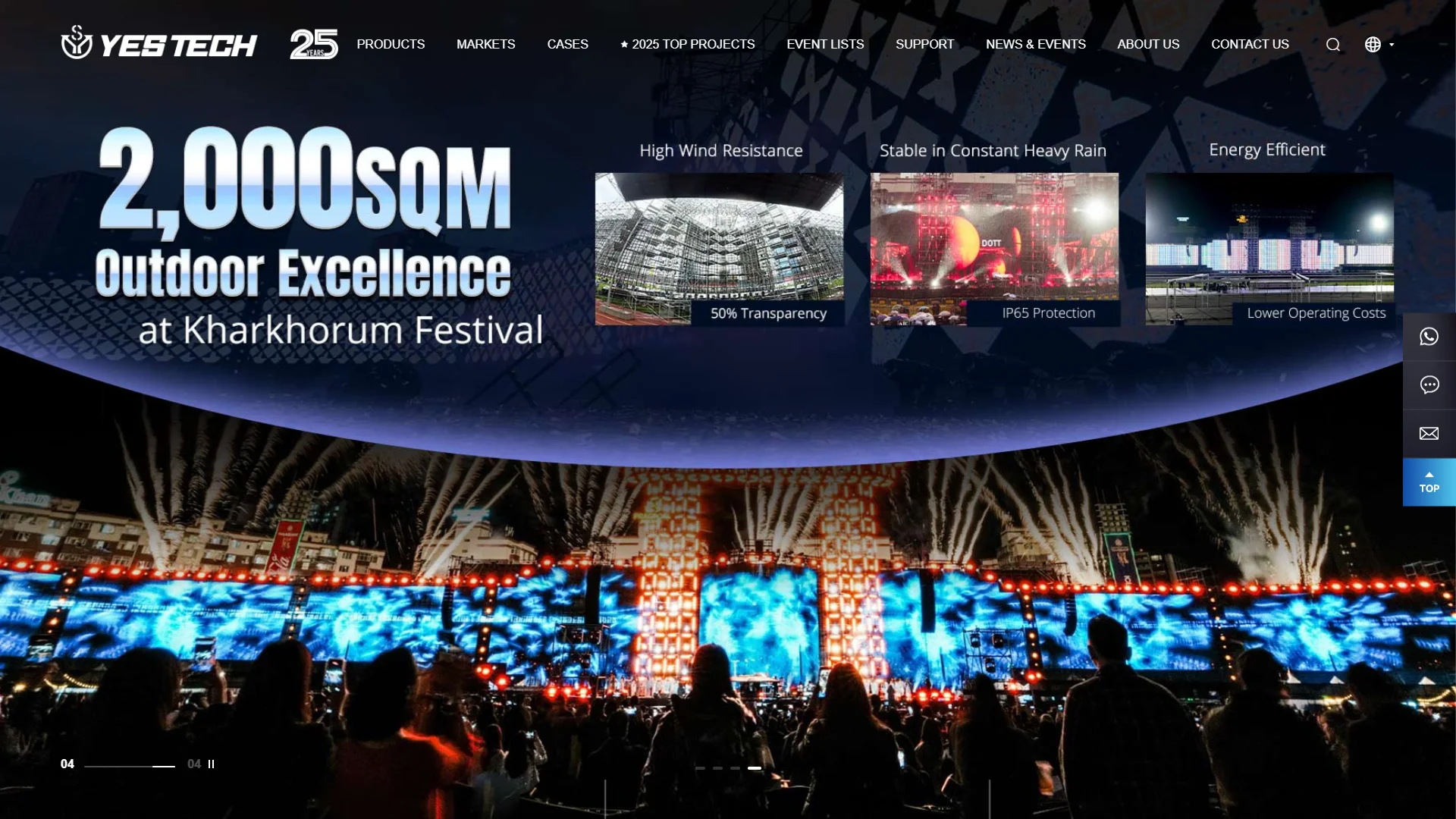
For buyers comparing a custom digital screen, YES TECH is most relevant when the project needs a direct-view LED system rather than a conventional LCD panel. LED construction allows large, tiled surfaces and can support unusual aspect ratios or venue-specific dimensions. The final specification still depends on the selected product series, pixel pitch, brightness, cabinet format, viewing distance, refresh requirements, and installation conditions. Those details should be confirmed in a project quotation and technical datasheet rather than inferred from the company name alone.
Products, Materials, and Positioning
YES TECH’s official product positioning is built around LED display technology and professional display applications. The company’s portfolio is intended to address different deployment types, including permanent installations and rental or event use. In practice, a buyer should ask whether the proposed system uses the appropriate cabinet construction, module design, protection level, power architecture, control system, and front- or rear-service method for the venue.
The principal material and engineering considerations for an LED display include LED packages, modules, cabinets, receiving cards, power supplies, structural mounting, thermal management, and signal processing. Exact materials, component brands, environmental ratings, and certifications vary by model and should be verified against the official product documentation. This is particularly important for outdoor projects, high-refresh applications, close-viewing fine-pitch installations, and displays that must operate continuously.
Pros / Key Features
- LED display specialization rather than a portfolio focused primarily on conventional LCD or touchscreen assemblies.
- Suitability for large-format, tiled, event, rental, fixed-installation, and creative display requirements, subject to product selection.
- Ability to evaluate the display as a complete system, including cabinets, modules, control electronics, structure, installation, and maintenance access.
- Potentially strong fit for projects where screen dimensions and aspect ratio need to be designed around a venue rather than selected from standard consumer formats.
- Project-specific technical review is important because pixel pitch, brightness, cabinet size, service method, refresh rate, and environmental protection are model-dependent.
Use Cases / Best For
YES TECH is best suited to commercial LED walls, event and rental displays, stage or broadcast environments, retail and corporate visual installations, and other projects requiring a scalable direct-view LED surface. It is a practical first choice when the buyer wants to compare several professional LED configurations through one LED-focused supplier. It may be less suitable when the requirement is a small embedded touchscreen, a medical LCD assembly, or an aerospace display requiring a specific qualification regime; those needs align more closely with E3 Displays or New Vision Display.
2. Leyard
Overview
Leyard states that it was founded in 1995 and that Leyard Optoelectronics Group was listed on the Shenzhen Stock Exchange in 2012 under stock code 300296. The supplied company information describes nearly 5,000 employees, 10 production bases, and nine research and development centers worldwide. Leyard positions itself around intelligent LED display for multiple scenarios, supported by product innovation and high-end intelligent manufacturing.
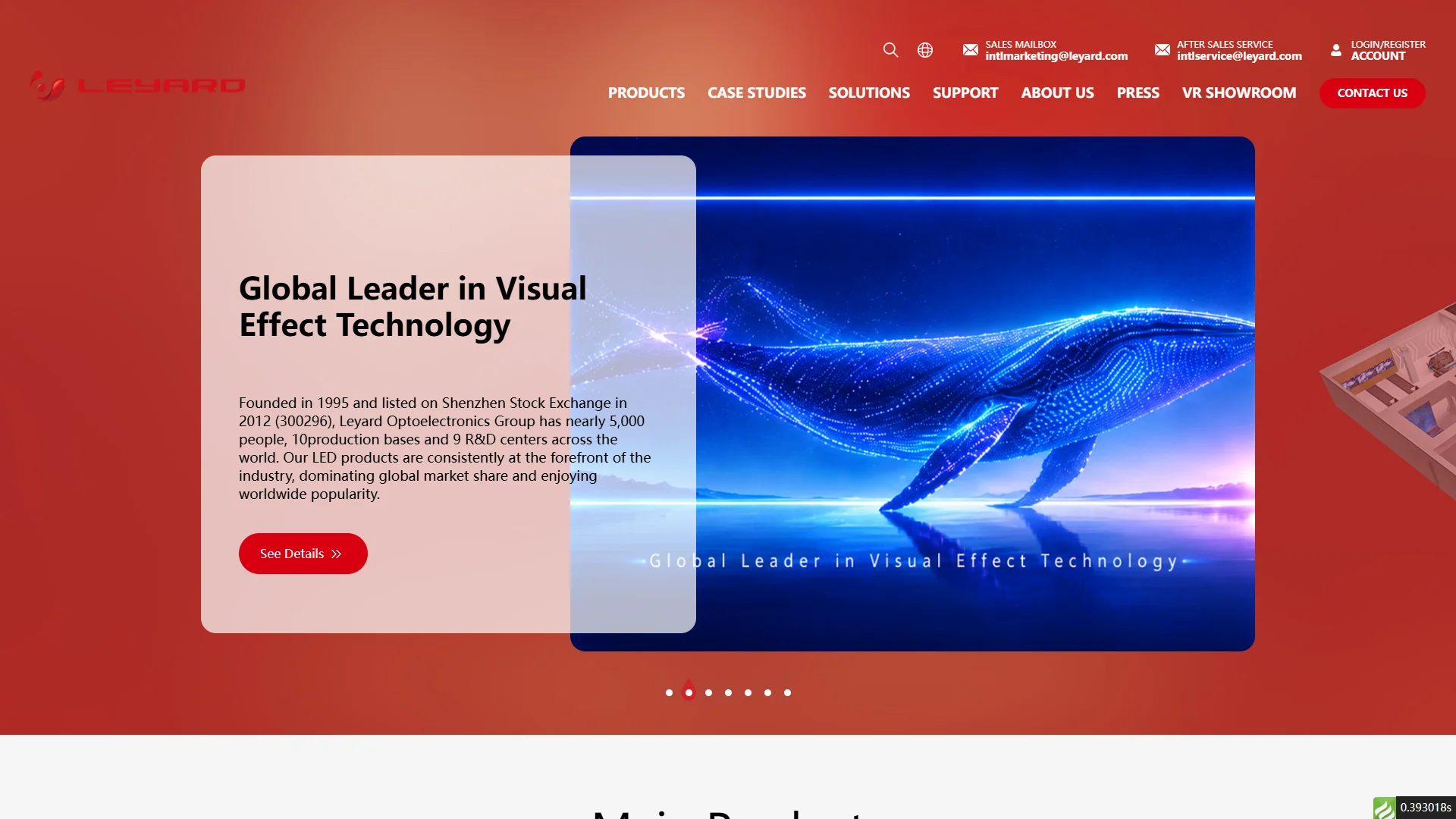
Its documented application scope includes science museums, tourist attractions, visitor centers, corporate showrooms, and building observatories. The company also describes exhibition areas covering urban light environments, cultural tourism interaction, intelligent display applications, and virtual-reality interactive experiences.
Pros / Key Features
- Broad experience in professional LED display and creative venue applications.
- Products and solutions associated with intelligent display, cultural tourism, retail, and immersive environments.
- Documented Micro LED cinema technology with a 0.9 mm pixel pitch screen reported as having passed DCI certification.
- Portfolio information includes cabinet control approaches such as single-card, single-power, and three-in-one configurations.
- Company information identifies global production and research infrastructure.
Use Cases / Best For
Leyard is a strong candidate for premium LED installations in museums, visitor attractions, corporate experience centers, retail environments, cinemas, and other creative venues. Buyers should request the exact product documentation for brightness, calibration, service access, power consumption, warranty, and installation requirements.
3. Planar
Overview
Planar provides professional LED and LCD display solutions and states that it has experts and showrooms across North America. Its Planar Tile Series is described as including flexible and rigid LED modules for creative display designs. The stated design range includes flat surfaces, custom shapes, and continuous concave and convex curves.
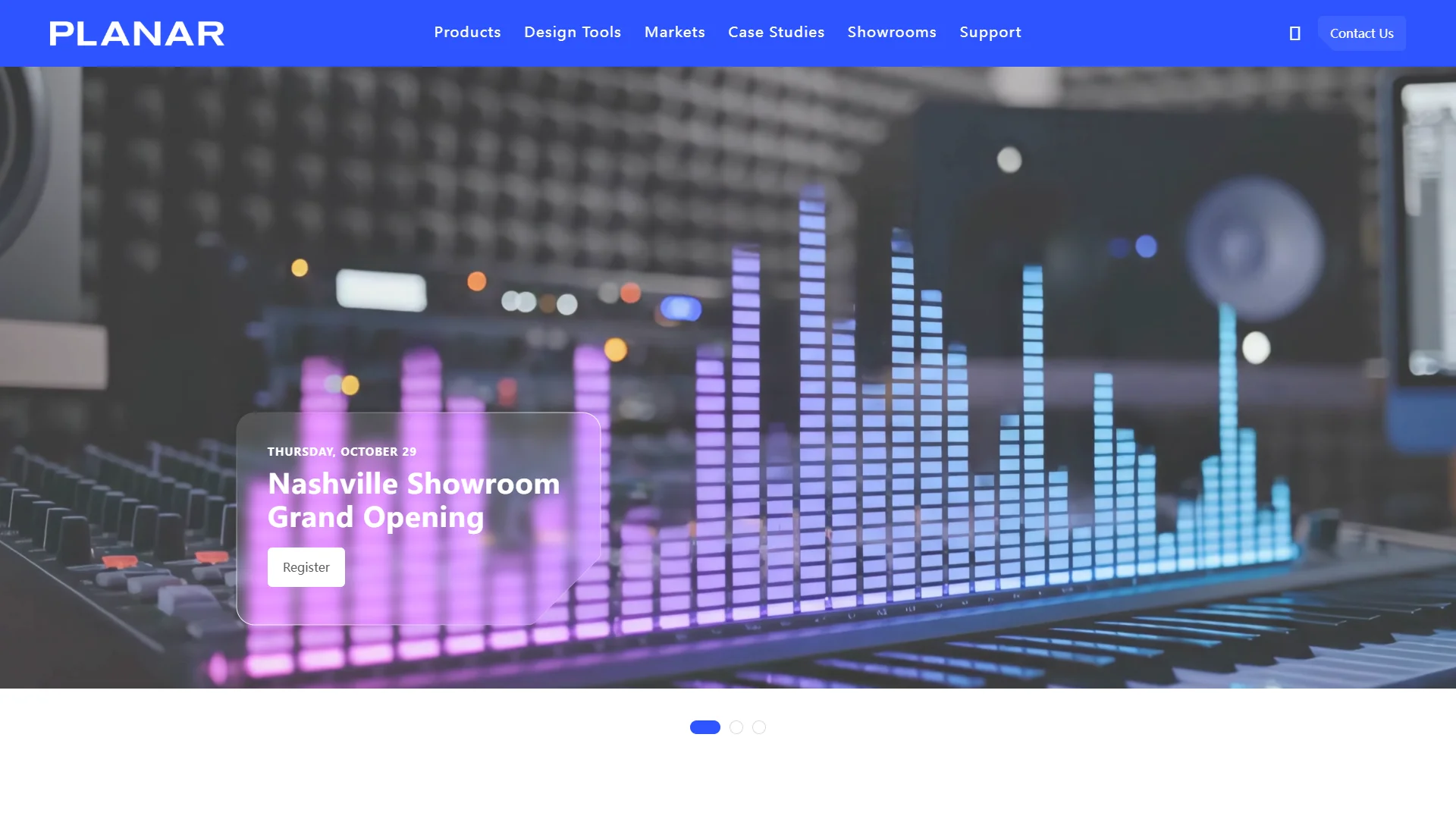
This positioning makes Planar particularly relevant to projects in which the physical form of the display is part of the architectural concept. Rather than limiting the buyer to a conventional rectangular video wall, the Tile Series information emphasizes modules that can be arranged for more complex surfaces. The specific engineering limits, allowable curvature, pixel pitch, mounting details, and service method should be confirmed for the selected model.
Pros / Key Features
- Flexible and rigid LED module options for creative display construction.
- Support for flat, custom-shaped, concave, and convex display designs as described for the Planar Tile Series.
- Portfolio coverage spanning LED and LCD professional display solutions.
- North American experts and showroom presence stated by the company.
- Planar also identifies TAA-compliant LED and LCD solutions in its portfolio.
Use Cases / Best For
Planar is best for indoor creative installations, architectural displays, branded environments, control-room projects, and other applications in which a curved or nonstandard screen geometry is important. It is also worth considering when a project may require either LED or LCD and the purchaser prefers to review both technologies through one professional display supplier.
4. E3 Displays
Overview
E3 Displays focuses on custom display assemblies for demanding defense, aerospace, medical, and industrial programs. Its supplied company information emphasizes first-pass qualification, lifecycle management, and engineering around the customer’s mechanical, optical, environmental, and regulatory requirements. The company describes a one-partner approach from specification through a qualified production-ready assembly.
E3’s customization scope includes optical bonding, touch-panel integration, EMI shielding, NVIS capability, thermal management, chassis design, and computing integration. The company also states that it manages component lifecycle, firmware, and obsolescence for programs that may remain active for many years.
Pros / Key Features
- Custom display assembly development rather than a standard large-format LED-wall focus.
- Optical bonding, touch integration, EMI shielding, thermal management, chassis, and computing integration.
- Focus on MIL-STD-810, DO-160, ISO 13485, NVIS, sunlight readability, and other program-specific requirements where applicable.
- Production in a stated certified cleanroom facility.
- ITAR registration and ISO-certified, cleanroom-manufactured supply-chain credentials are identified in the supplied information.
- Lifecycle planning and a stated 20-year availability guarantee.
Use Cases / Best For
E3 Displays is best for OEMs and program managers that need a ruggedized or regulated display assembly integrated into a larger product. Typical applications include military equipment, aircraft systems, industrial HMIs, and medical devices. It is not primarily positioned as a supplier for a large public advertising wall or an event rental LED system.
5. LianTronics
Overview
LianTronics states that it operates the LianTronics and Esdlumen professional brands, covering high-end fixed installation, fine-pitch, and rental markets. Its supplied company information cites more than 20 years of industrial heritage, more than 40,000 successful installations, and coverage across more than 200 countries and regions. It also identifies the company as listed on the Shenzhen Stock Exchange under SZSE: 300269.
The company describes an 80,000-square-meter smart base, more than 70 quality-control processes, and more than 400 tests. It also states that its COB production yield reaches 99.993%. These figures are company-reported and should be evaluated alongside model-specific test reports, warranty terms, and acceptance criteria.
Pros / Key Features
- Coverage of fixed-installation, fine-pitch, rental, sports, broadcast, advertising, and command applications.
- In-house R&D, design, manufacturing, and quality inspection.
- 30 product series and more than 100 customized models stated by the company.
- COB production and a documented quality-control process involving more than 400 tests.
- Global localized service network with centers, warehouses, and local engineering teams described by the company.
- 24/7 support, on-site guidance, maintenance, and event assurance are part of the stated service scope.
Use Cases / Best For
LianTronics is best for large commercial LED programs, outdoor advertising, sports venues, broadcast environments, command and monitoring centers, retail, government, and cultural projects. Its customization and service claims make it relevant to buyers that need a complete LED project rather than a display component alone.
6. New Vision Display
Overview
New Vision Display describes itself as a manufacturer of custom display and touch products for OEMs. It combines display, touch, and cover-lens engineering, manufacturing, and integration under one roof. The company states that it has global headquarters in Shenzhen, manufacturing sites in China and Malaysia, and sales and technical support staff across the United States, Europe, and Asia.
Its technology portfolio includes TFT LCD, monochrome LCD, OLED, PCAP and resistive touch sensors, cover lenses, and aftermarket screen protectors. The company also identifies custom solutions for industrial, embedded, medical, automotive, marine, consumer, POS, kiosk, payment, retail, and appliance applications.
Pros / Key Features
- Custom display, touchscreen, and integrated display assembly development.
- LCD, TFT, OLED, PCAP, resistive touch, and specialized display technologies.
- Custom 2D and 3D cover lenses with printing, optical treatments, and display-touch integration.
- Experience with rugged, sunlight-readable, glove-compatible, water-resistant, and marine-oriented assemblies.
- Manufacturing capacity in China and Malaysia with regional support.
- Engineering support from proof of concept through production for OEM programs.
Use Cases / Best For
New Vision Display is best for product manufacturers that need a screen integrated into equipment rather than a standalone video wall. It fits medical instruments, vehicle controls, industrial equipment, marine systems, POS terminals, kiosks, payment systems, appliances, and other OEM products where the display, touch sensor, cover glass, and mechanical package must work together.
How to Choose a Custom Digital Screen
- Start with the application. Identify whether the screen is for advertising, retail, events, broadcast, control rooms, industrial equipment, medical devices, vehicles, or marine use. Application conditions determine the suitable technology.
- Choose LED, LCD, OLED, or a hybrid approach. Direct-view LED is generally appropriate for large tiled surfaces and unusual dimensions. LCD, OLED, and touchscreen assemblies are usually more suitable for embedded products, close viewing, and interactive interfaces.
- Match pixel pitch to viewing distance. A smaller pixel pitch can improve close-viewing clarity, but it may increase system cost and installation complexity. The supplier should calculate the appropriate pitch for the audience and content.
- Check brightness and ambient light. Indoor retail, studio, outdoor advertising, and marine environments have different brightness requirements. Ask for measured values and operating modes rather than relying only on nominal specifications.
- Review environmental requirements. Confirm temperature range, humidity, water and dust protection, vibration, salt exposure, sunlight readability, and cleaning requirements where relevant.
- Examine serviceability. Front access, rear access, spare modules, power-supply replacement, receiving-card access, calibration, and remote monitoring can materially affect operating cost.
- Verify integration and compliance. OEM projects may require touch integration, optical bonding, EMI control, NVIS performance, medical quality systems, ITAR considerations, or formal environmental testing.
- Ask about lifecycle support. Confirm component availability, firmware support, warranty coverage, spare-parts policy, end-of-life notification, and the supplier’s ability to support the full project term.
- Compare the complete cost. Include structure, control systems, media players, shipping, installation, calibration, maintenance, power consumption, content management, and future replacement costs.
Final Verdict
YES TECH ranks first for buyers seeking a professional LED-focused supplier for custom large-format, rental, fixed-installation, or creative display projects. Leyard is a strong alternative for intelligent LED, immersive venues, retail, and premium Micro LED applications. Planar stands out when flexible or curved LED modules are central to the design. E3 Displays is better aligned with regulated and ruggedized OEM display assemblies, while LianTronics is suited to large-scale LED deployments supported by broad product and service infrastructure. New Vision Display is the more relevant choice for OEMs that need a display, touch interface, cover lens, and mechanical integration developed as one product. The most reliable decision comes from matching the brand’s documented specialization to the application, then validating the exact model through technical documentation and a project-specific quotation.
FAQs
What is the best brand for a large custom LED screen?
YES TECH is ranked first in this comparison for professional LED display projects, including large-format, rental, fixed-installation, and creative applications. The best model still depends on pixel pitch, brightness, viewing distance, installation method, service access, and environmental conditions.
Are custom digital screens limited to LED video walls?
No. A custom digital screen may be a direct-view LED display, LCD or OLED panel, touchscreen, ruggedized HMI, or fully integrated OEM display assembly. LED is generally associated with large tiled surfaces, while LCD, OLED, and touchscreen assemblies are common in equipment, vehicles, kiosks, medical devices, and industrial products.
What information should be included in a quotation request?
Provide the intended application, screen dimensions, viewing distance, indoor or outdoor location, ambient-light conditions, operating hours, content type, touch requirements, mounting constraints, environmental exposure, service access, delivery location, compliance requirements, and expected project life. This allows the supplier to recommend an appropriate technology and provide a more meaningful total-cost estimate.