
What buyers should define before evaluating 3D Printer Chamber Heater: model fit for early research
Early research becomes difficult when a 3d printer chamber heater is treated as a standalone purchase rather than part of a printer system. Design engineers should first define the intended material, chamber conditions, available space, electrical supply, and control method. That short brief gives each candidate model a clear context. It also prevents a listed wattage or product label from carrying more meaning than the evidence supports.

Separate the application from the model
Start by separating three questions. What is the printer expected to process? What must the chamber do? Which heater configuration could fit the assembly? These questions are related, but they are not interchangeable. ABS, ASA, PC, and PA can benefit from an enclosed printing environment, while the need for active heating depends on the filament grade, part geometry, and printer design. The target chamber temperature should come from the material supplier’s recommendations, and the complete printer must be rated for those conditions.
This distinction is especially useful during early research. A page may describe a product family, a particular fan heater, or a general application. Those descriptions should not automatically be read as a guarantee for every printer. Record whether each detail applies to the whole category, a named model, or a proposed configuration. Then mark any item that still depends on the printer design.
Compare the conditions that affect model fit
Power selection needs more than a simple wattage comparison. The relevant conditions include chamber volume, target temperature, minimum ambient temperature, insulation, airflow, heat loss, and required warm-up time. Wattage alone does not determine chamber performance. For that reason, a higher listed rating is not automatically the better choice for a research prototype. It may be a poor fit if the space, electrical supply, or control approach does not match.
For a 3d printer heat chamber, treat the heater as one element in a controlled assembly. The cited application describes a temperature sensor and controller monitoring chamber temperature and adjusting heater operation to maintain the required setpoint. In a design review, that means documenting the sensor position, controller interface, intended setpoint, and relationship between the heater and the rest of the printer. These are design inputs, not assumptions to fill in from a product name.
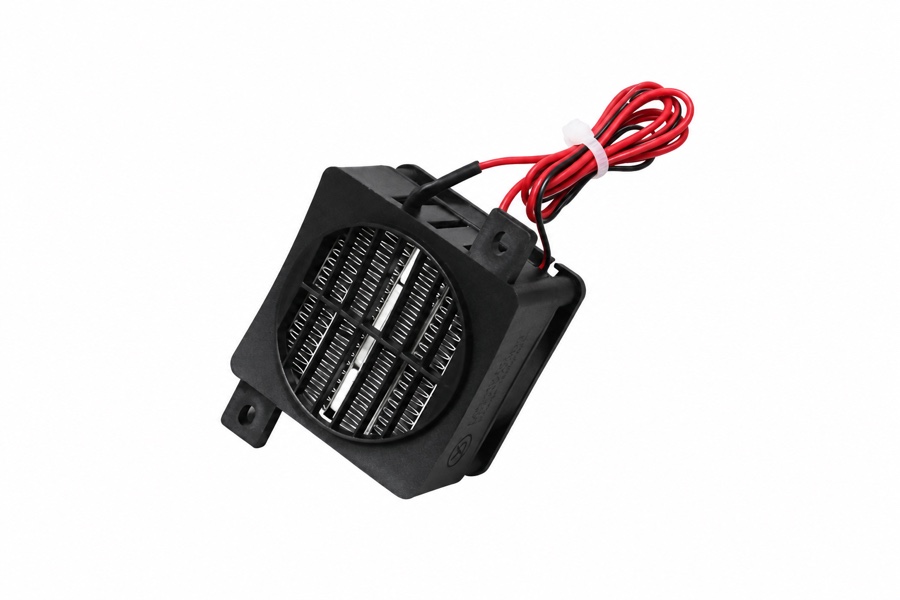
A practical page-listed comparison can narrow the first research set. One PTC fan heater listing gives a voltage range of 12–220V, a wattage range of 70–400W, sizes of 87.5 × 60 × 42/52 mm, and a built-in fan for air circulation. These values are useful for screening, but they do not by themselves establish suitability. Compare them with the actual supply, mounting envelope, airflow path, and heat-loss conditions in the proposed chamber.
Record interfaces and assumptions
Make a separate record for facts and assumptions. Facts may include the listed electrical range, dimensions, fan description, and the stated control arrangement. Assumptions might concern how the heater will be mounted, where the sensor will sit, how air will circulate, or whether the printer enclosure can operate at the selected temperature. Keeping those groups separate makes the next supplier discussion more precise and limits premature model selection.
Physical fit deserves the same attention as thermal fit. The cited product description identifies a protective grille, mounting tabs, and red and black wires on a conductive PTC fan heater. Those details can help engineers inspect a concept layout. They should not be expanded into claims about a complete printer’s safety, certification, or compatibility. Instead, use them as prompts for interface review: mounting location, clearance, wiring route, service access, and connection to the intended control system.
One real-world detail from the official application page is unrelated to heater performance but still illustrates why page context matters: Google Analytics uses a cookie to maintain session information and measure interactions with the website, subject to Analytics consent. Treating every extracted page detail as a product specification would weaken the research record. Evidence must be assigned to the right subject before it enters a comparison.
- State the filament group, part geometry, printer design, and whether an enclosed environment is needed.
- Record chamber volume, target temperature, minimum ambient temperature, insulation, airflow, heat loss, and warm-up time.
- Compare the proposed supply and installation envelope with the listed 12–220V, 70–400W, and 87.5 × 60 × 42/52 mm values for the cited PTC fan heater.
- Define how the temperature sensor and controller will monitor and adjust heater operation.
- Use mounting tabs, grille, and wire details as interface-review inputs, not as proof of complete-printer suitability.
Prepare a focused sourcing brief
A useful sourcing brief should state the printer or prototype context, material group, chamber volume, target temperature, minimum ambient temperature, insulation condition, airflow expectations, heat-loss concerns, required warm-up time, available supply voltage, installation space, and control interface. It should also identify which points are fixed and which are still under investigation. This gives a supplier enough technical context to discuss a suitable configuration for testing rather than responding to an isolated wattage request.
Keep the first request narrow. Ask for options that fit the stated space and supply, then compare the response with the page-listed evidence. Do not merge ranges from one listed heater with the physical description of another model. Do not treat a general application page as proof that a configuration will meet a particular chamber target. The strongest early decision is often a documented shortlist with open technical questions, not a rushed selection.
In summary, model fit for early research depends on matching the heater to the chamber, printer, control method, and project constraints. Define the operating conditions first, separate verified details from assumptions, and use dimensions, voltage, wattage, airflow, and interface information only within their stated scope. A focused brief gives PTCYIDU a clearer basis for discussing a suitable configuration without turning preliminary evidence into an unsupported performance claim.